


GDPR

SOC2-TYPE2
High Performer 2026
Highest User Adoption 2026
Data models and components that live in your own repo, version-controlled and reviewed. Developers and agents can extend and push these assets to Embeddable using the SDK.
Open source and fully extensible. Use ours, customize, or write your own — by hand or with an agent.
Cube-based data models define and manage access to your data. Define metrics once yourself or via an AI agent - for consistency, maintainability, and speed.
cubes:
  - name: accounts
    measures:
      - name: revenue
        type: sum
    dimensions:
      - name: tier
        type: string
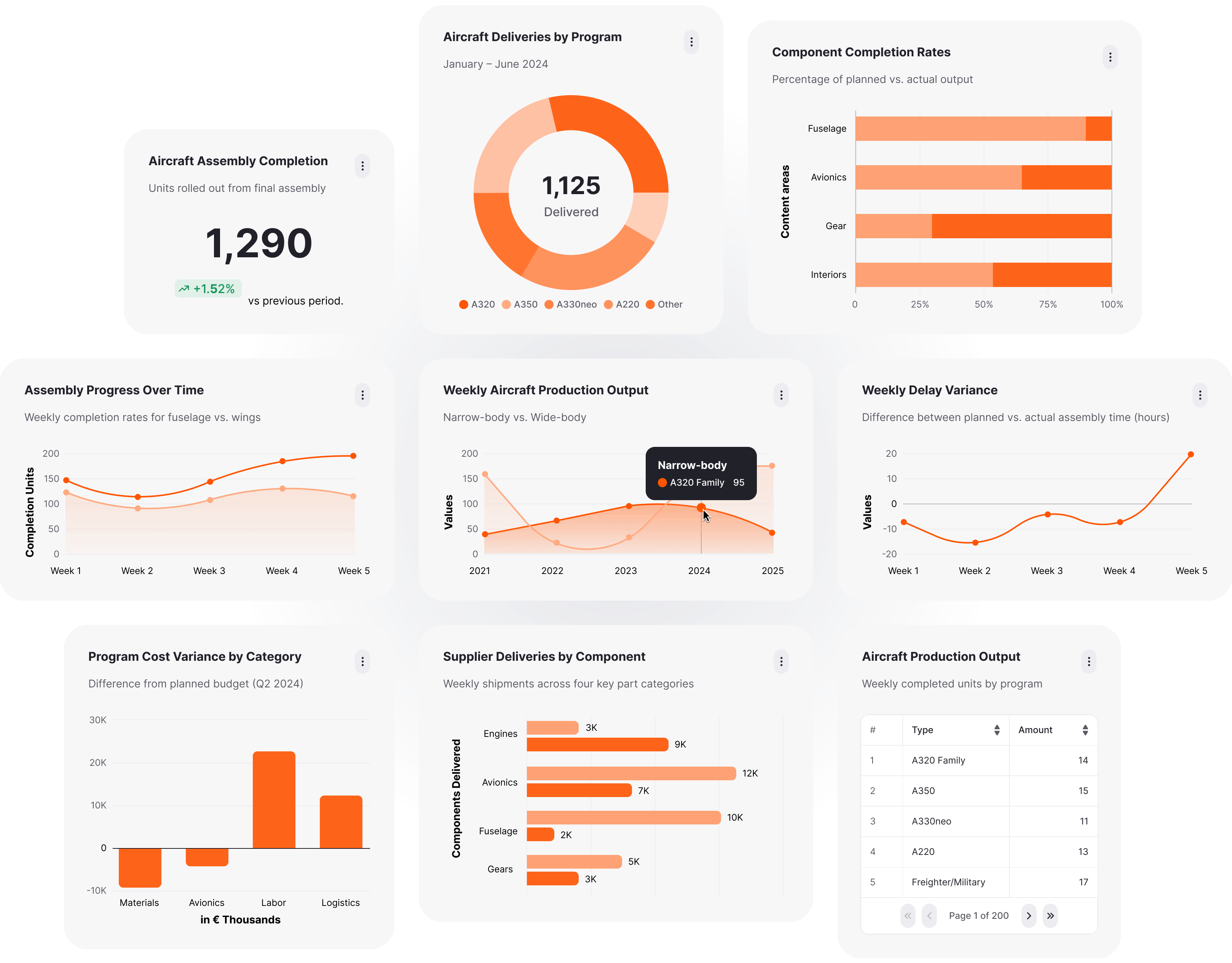
Models and components combine into native data experiences - complete with drilldown, self-serve, and conversational insights - in code, our no-code builder, or by asking an agent.
name: Executive overview
models: [accounts, transactions]
components:
  - kpichart:
      value: accounts.revenue
  - linechart:
      data: transactions
One web component drops into any app - React, Vue, plain HTML. Native, not an iframe. With server-side security tokens for a seamless experience.
Multi-and-single-tenant secure, fully audited, SOC 2 Type 2. We handle the hard infrastructure so you can focus on the experience.
A code-first foundation
Data models and components that live in your own repo, version-controlled and reviewed. Developers and agents can extend.
A world-class component library
Open source and fully extensible. Use ours, customize, or write your own - by hand or with an agent.
A governed semantic layer
Cube-based data models define and manage access to your data. Define metrics once yourself or via an AI agent - for consistency, maintainability, and speed.
cubes:
  - name: accounts
    measures:
      - name: revenue
        type: sum
    dimensions:
      - name: tier
        type: string
Dashboards, composable in code
Models and components combine into native data experiences - complete with drilldown, self-serve, and conversational insights - in code, our no-code builder, or by asking an agent.
name: Executive overview
datasets: [accounts, transactions]
widgets:
  - kpichart:
      value: accounts.revenue
  - linechart:
      data: transactions
Native embedding in one tag
One web component drops into any app — React, Vue, plain HTML. Native, not an iframe. With server-side security tokens for a seamless experience.
Production-ready from day one
Multi-and-single-tenant secure, fully audited, SOC 2 Type 2. We handle the hard infrastructure so you can focus on the experience.




AI can help you scaffold dashboards, models, and UI faster. But customer-facing analytics still needs to become a production system: permissions, trusted metrics, tenant isolation, performance, auditability, and ongoing maintenance. Embeddable gives your team the infrastructure layer underneath, so developers and agents can move faster without owning the full long-term system burden.
Dashboards as code means your analytics experience can be defined, versioned, and managed in a developer workflow. Your team keeps control of components, layouts, data models, theming, and product logic, while Embeddable handles the production layer underneath: performance, security, self-serve infrastructure, and auditability.
Yes. Embeddable is being designed for teams using AI tools to accelerate dashboard development. The goal is to make it easier for developers and agents to scaffold, edit, and deploy customer-facing analytics while keeping the resulting experience production-ready, governed, and maintainable.
Embeddable handles the parts that become hard to own at scale: secure access across tenants and roles, governed self-serve infrastructure, performance and caching, trusted definitions, auditability, and operational visibility. Your team owns the product experience; Embeddable handles the trusted layer beneath it.
Yes. Embeddable dashboards are designed to feel like part of your application, not a separate BI tool. You can use your own design system, components, and visual language, and dashboards render directly inside your application experience rather than through a generic embedded BI surface.
No. Embeddable dashboards can be embedded using native web components, with support for modern front-end environments. This helps analytics feel more integrated, performant, and flexible than traditional iframe-based embedding.
Yes. Embeddable supports controlled self-serve, so your customers can explore, filter, save views, and create or extend dashboards within the boundaries you define. You control which datasets, metrics, components, and permissions are available, so users get flexibility without breaking trust or access rules.
Self-serve is governed through your data models, permissions, and access rules. Users can explore and create within the experience you expose to them, while metric definitions, role-aware access, and tenant boundaries remain enforced.
Yes. Embeddable connects to your data source and does not need to copy your underlying customer data into a separate analytics warehouse. Data models define what can be queried and by whom, while secure connection and access patterns keep control with your team.
Embeddable supports security patterns for production customer-facing analytics, including encrypted connections, secure access controls, row- and/or database-level security, and tenant-aware permissions. Embeddable is SOC 2 Type II certified and GDPR compliant.
Embeddable is built for single-tenant and multi-tenant applications. You can enforce row-level security, scope access by user or tenant, and support different database environments or data structures depending on your architecture.
Embeddable’s AI direction is built around guardrails. AI-generated queries and insights should operate through the customer-defined semantic layer, with approved metrics, row-level access, validation, and auditability applied before anything is rendered to users.
The goal is for AI-assisted dashboard creation to use your actual component library and design system, rather than generic chart defaults. That means AI can help accelerate creation while the output still feels like part of your product.
Start by speaking with the Embeddable team or exploring the developer documentation. Most teams begin by connecting a data source, defining models and components, and embedding a first dashboard or chart into their application.

Build remarkable analytics experiences
Embeddable is registered as TMD Technology Limited (no. 13856879), at International House, 142 Cromwell Road, London, SW7 4EF.

